Hybrid Application Service (HAS)
⚠️ Deprecated — retained for historical reference only. HAS has been superseded. Its repository (
redhat-appstudio/application-service) is archived on GitHub. If you landed here because you are onboarding to Konflux, go to Build Service instead — that is where Component provisioning and webhook logic live today.For the authoritative record of why and how HAS was replaced, see ADR-0056 (Implementable) and ADR-0060 (Proposed).
# Background
The name “Hybrid Application Service” appears in older ADRs, git blame outputs, and archived GitHub issues without explanation. This page documents what HAS did and what replaced it — useful context when reading the Konflux commit history or tracing why certain design decisions were made.
HAS is not operational. Nothing here should be used as a reference for new work.
# What HAS was
HAS was a Kubernetes operator that sat in the admission path for two custom resources:
Application and Component. Its sole job was enforcement — making sure those objects
met shape and relationship constraints before the API server persisted them.
It did not run pipelines. It did not schedule builds. It did not talk to any external system. It only intercepted API server requests and either allowed them (possibly with mutations) or rejected them with a reason.
Kubernetes exposes two admission webhook types:
- Validating webhooks — read the incoming object, return allow or deny.
- Mutating (defaulting) webhooks — read the incoming object, return allow plus a JSON Patch that the API server applies before persisting.
HAS used both kinds.
# The four webhooks
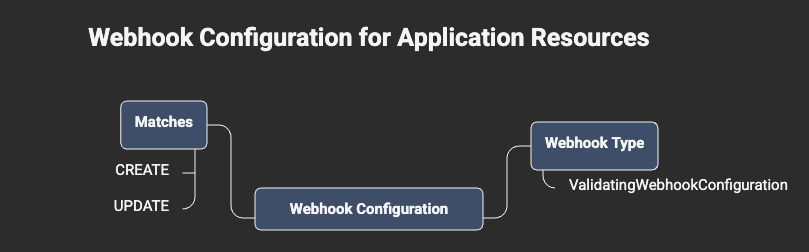
# 1. Application validation webhook
Webhook type: ValidatingWebhookConfiguration
Matches:      CREATE and UPDATE on Application resources
This webhook checked that:
metadata.namematched the Kubernetes DNS-subdomain name format (/^[a-z0-9]([-a-z0-9]*[a-z0-9])?$/).spec.displayName, if set, did not contain characters that downstream services could not safely render (control characters, certain Unicode ranges).
If either check failed, the API server returned a 403 with HAS’s error message directly
to the kubectl caller. The Application was never written to etcd.
Why this mattered. Several Konflux services embedded the application name into
annotation values, label selectors, and PipelineRun names. A name like my app with a
space would silently corrupt label selectors further down the pipeline, producing
failures that were very hard to trace back. Catching it at admission time gave a clear,
immediate error before any downstream state was written.
# 2. Component validation webhook
Webhook type: ValidatingWebhookConfiguration
Matches:      CREATE and UPDATE on Component resources
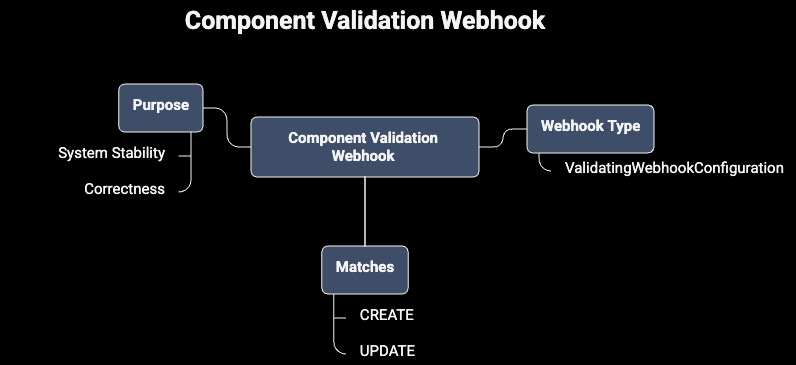
This webhook enforced three things:
spec.applicationmust reference anApplicationthat exists in the same namespace.metadata.namemust follow the same DNS-subdomain rules as Application names.spec.sourcemust contain exactly one ofgitorimage, and the chosen field must be structurally valid (a git source needs at minimum aurl).
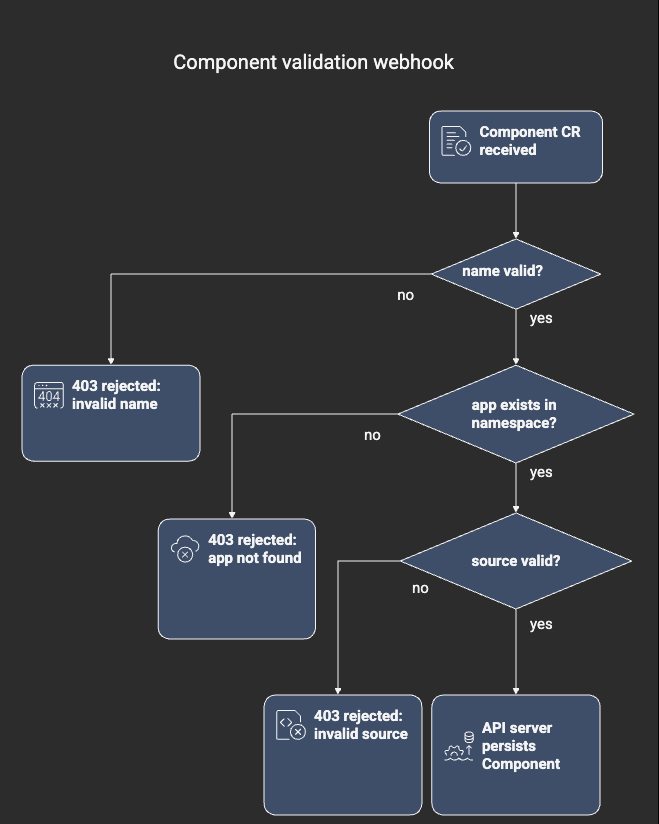
The source validation was particularly important because Build Service read
spec.source.git.url without defensive checks — it assumed HAS had already validated
the shape before the object landed in etcd.
# 3. Component defaulting webhook
Webhook type: MutatingWebhookConfiguration
Matches:      CREATE on Component resources
This webhook ran before the validating webhook in the admission chain. It added an
OwnerReference block to the Component manifest pointing at its parent Application:
ownerReferences:
  - apiVersion: appstudio.redhat.com/v1alpha1
    kind: Application
    name: my-app
    uid: <uid-of-the-application>
    blockOwnerDeletion: true
    controller: true
The controller: true flag tells Kubernetes garbage collection to treat the
Application as the owning controller. When you deleted an Application, Kubernetes
automatically deleted all Component objects that carried this reference — no custom
finalizer logic was needed in any other controller.
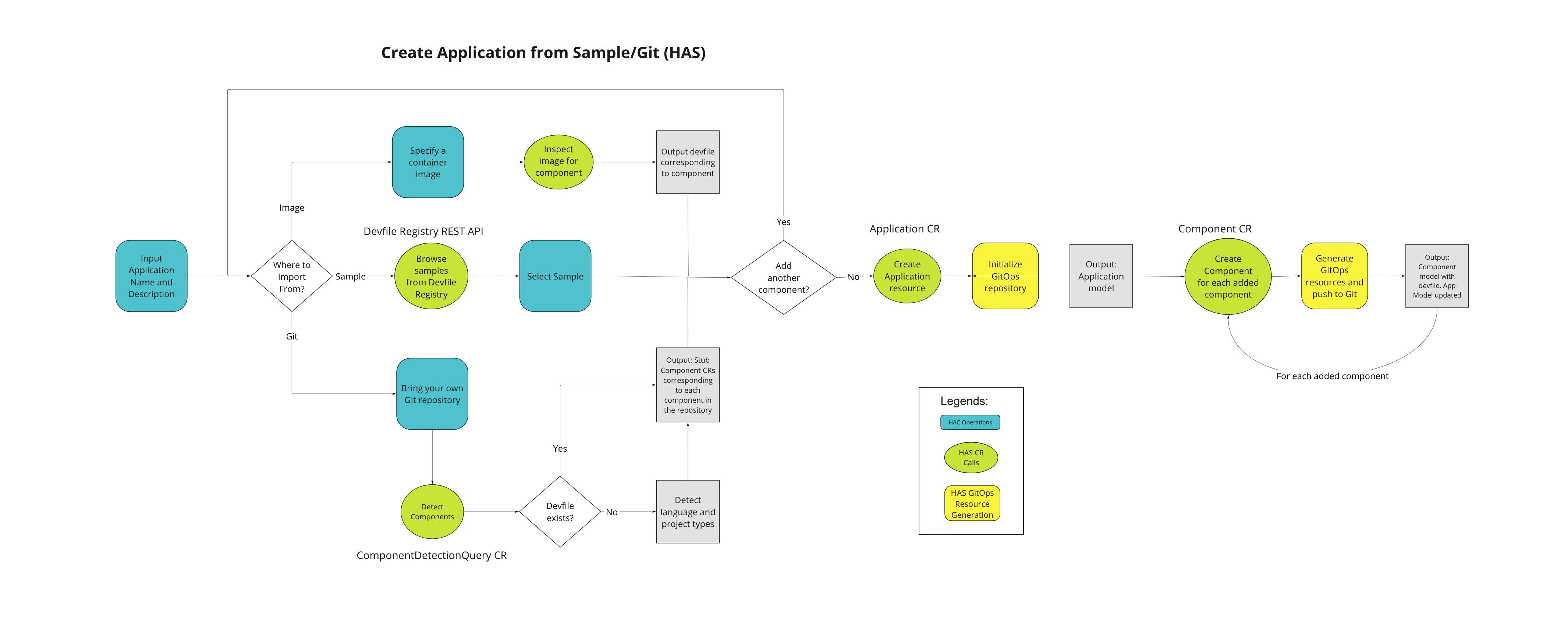
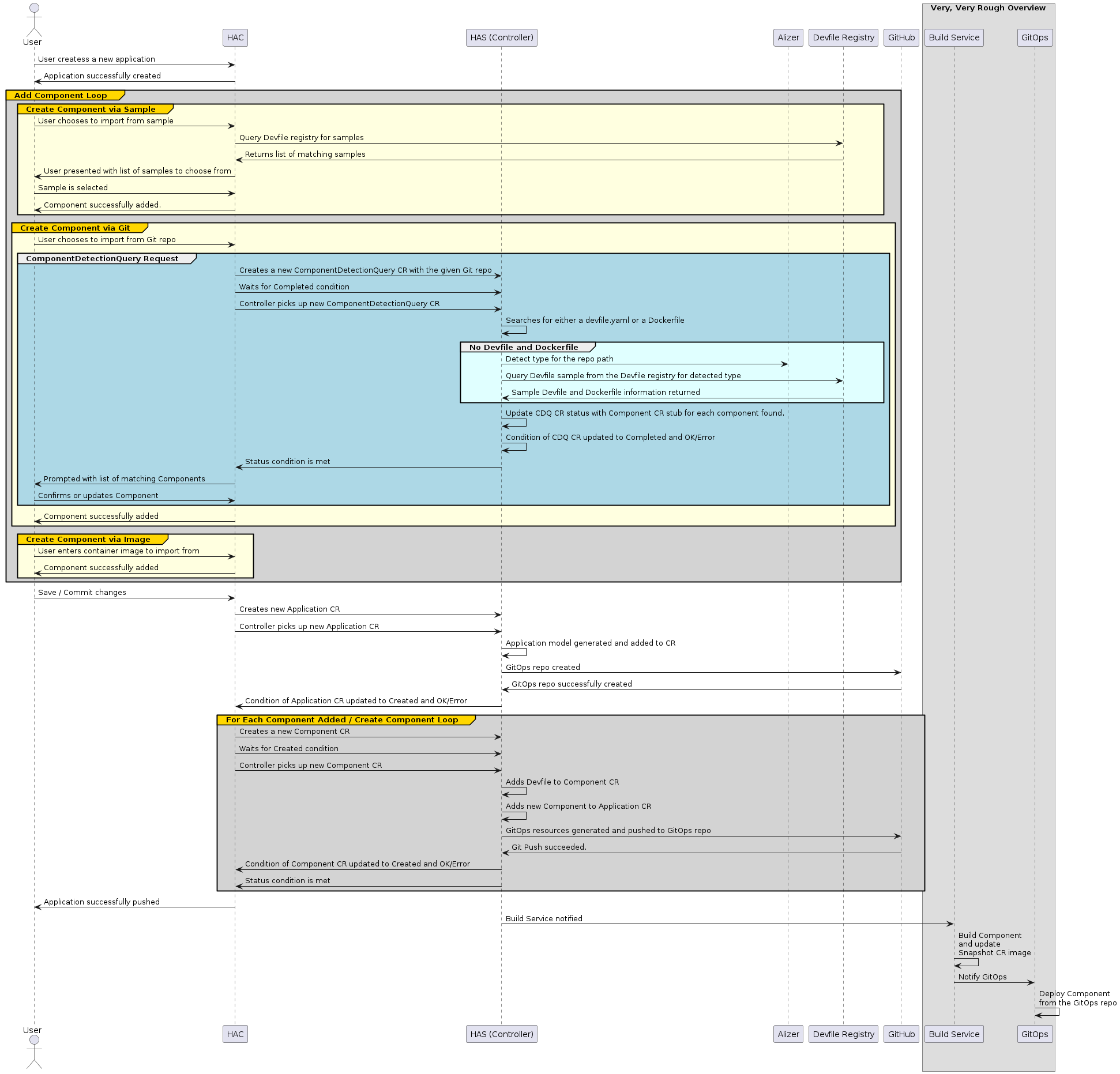
The diagram below (preserved from the original HAS repository) shows the full sequence for application and component creation including the webhook call order:
# 4. BuildNudgesRef webhook
Webhook type: ValidatingWebhookConfiguration (with side effects — status writes)
Matches:      CREATE and UPDATE on Component resources where spec.build-nudges-ref changed
This was the most complex webhook. The spec.build-nudges-ref field on a Component
is a list of other component names in the same namespace that should get their image
reference bumped (nudged) when this component’s image is updated — a list of downstream
consumers.
The webhook maintained a bidirectional index. When component A listed component B in
spec.build-nudges-ref, the webhook wrote B’s name into A’s status and wrote A’s
name into B’s status field status.buildNudgedBy. This kept the graph queryable from
either direction without a full namespace scan.
For example, given a three-component nudge chain:
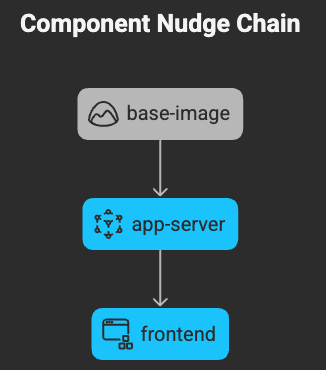
The resulting status fields would be:
base-image.status.buildNudgedBy:  []
base-image.spec.build-nudges-ref: [app-server]

app-server.status.buildNudgedBy:  [base-image]
app-server.spec.build-nudges-ref: [frontend]

frontend.status.buildNudgedBy:    [app-server]
frontend.spec.build-nudges-ref:   []
Build Service could then walk either direction of the graph without performing a full namespace-wide list operation.
The full application creation sequence (including all webhook interactions) is preserved below:
# How all four webhooks fit together
The admission chain for a Component creation request, showing webhook call order:
sequenceDiagram
    participant U as kubectl / UI
    participant API as kube-apiserver
    participant HAS as HAS webhooks
    participant ETCD as etcd

    U->>API: POST Application
    API->>HAS: ValidatingWebhook — name and displayName check
    HAS-->>API: allow
    API->>ETCD: persist Application

    U->>API: POST Component
    API->>HAS: MutatingWebhook — set OwnerReference
    HAS-->>API: allow + JSON Patch (adds ownerRef)
    API->>HAS: ValidatingWebhook — name, app-exists, source check
    HAS-->>API: allow
    API->>HAS: ValidatingWebhook — BuildNudgesRef bidirectional index update
    HAS-->>API: allow + status writes to referenced components
    API->>ETCD: persist Component (with ownerRef applied)
Admission order: Kubernetes runs all mutating webhooks before any validating webhooks. That is why the OwnerReference was always present by the time the component validator checked
spec.application— the mutating webhook had already patched the object in memory before the validator ran.
# CDQ (Component Detection Query)
HAS also included CDQ, the Component Detection Query controller, which ran independently of the four admission webhooks. When a user provided a repository URL without specifying which parts were buildable components, CDQ would scan the repository using devfile detection, Dockerfile detection, and similar heuristics, then return a list of detected component candidates.
The detection flow is shown below:
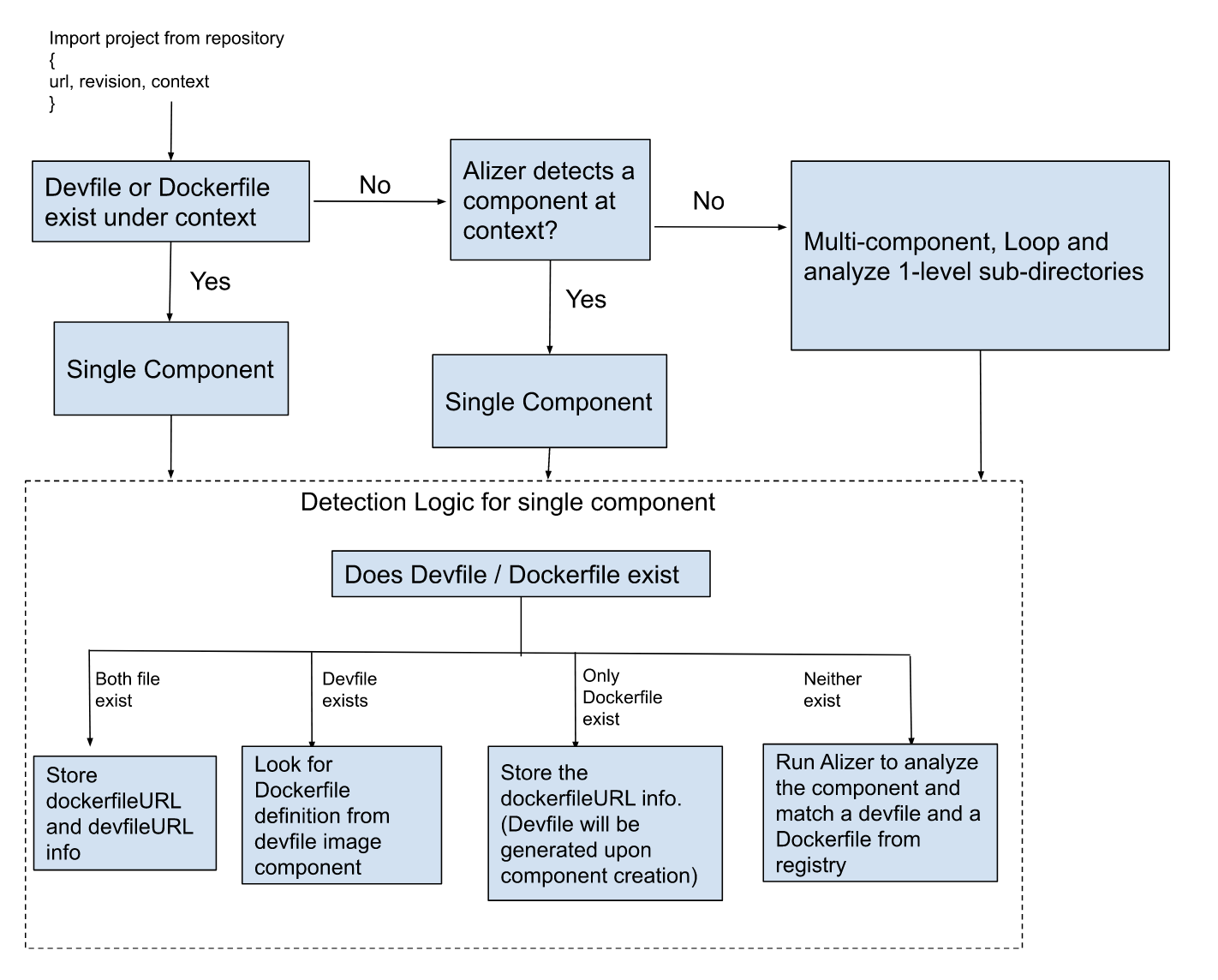
CDQ was not migrated to another service — the functionality was intentionally dropped as part of the Component model revision. The new model assumes users know what they want to build. Auto-detection added significant complexity and produced false positives in practice (for example, detecting the wrong Dockerfile in a monorepo).
# Why HAS was deprecated
The core problem was ownership and coupling. HAS owned the Application and Component
CRDs, but Build Service, Integration Service, Release Service, and the UI all had
load-bearing assumptions about those CRDs. Any schema change sent ripples across four
or five codebases simultaneously.
ADR-0056 identified three concrete problems:
1. One component = one branch. Building the same repository from two branches
(main and release-1.x) required two separate Component objects with duplicated
config. There was no concept of component versions. The new Component spec addresses
this with a spec.source.versions list.
2. One component = one application. The hard spec.application field meant a
component image could only belong to one release group. Putting it in two groups
required duplicating the component, which meant two separate build pipelines, two image
repositories, and images that drifted apart over time.
3. Unclear API ownership. With HAS deprecated, no service formally owned the
Application / Component CRD. ADR-0056 resolved this: Build Service owns Component,
and Integration Service owns the new ComponentGroup (replacing Application).
The migration replaced the four HAS webhooks as follows:
| Former HAS webhook | Replacement |
|---|---|
| Application name / displayName validation | CRD schema validation rules on the Application resource |
| Component shape validation (name, source, app reference) | CRD schema validation rules on the Component resource, owned by Build Service |
| OwnerReference defaulting | Managed by the Build Service controller |
| BuildNudgesRef bidirectional index | Build Service nudging controller (see build-service.md) |
# Component API type history
The Go types for Application, Component, and ComponentDetectionQuery did not stay
in one place. They moved twice, and if you are chasing an import path in older code you
need to know all three locations.
Stage 1 — HAS repo (original home)
The types were defined inside redhat-appstudio/application-service alongside the
webhook controllers. api/v1alpha1/ held the CRD structs, markers, and generated
zz_generated.deepcopy.go. Any service that used Application or Component objects
imported directly from this path.
Stage 2 — Consolidated API repo (intermediate)
As additional services needed the same types, vendoring the full HAS controller repo
created a large, awkward dependency. The types were extracted into a standalone
API-only repo: konflux-ci/application-api.
This repo contains no controllers or webhooks — only the CRD Go structs, generated
clients, and webhook registration markers. Services that were updated during this period
import from github.com/konflux-ci/application-api/apis/appstudio/v1alpha1.
The konflux-ci/application-api repo is still active today. It still exports the
Application CRD types, which remain in use while the transition described below
completes.
Stage 3 — Build Service (current, in progress)
With ADR-0056, the Component type is
being redesigned. As part of that redesign, ownership of the Component CRD moves from
the centralised application-api repo into
konflux-ci/build-service. The new
Component spec lives in build-service’s own api/ directory.
This means:
- New code importing
Componentshould use thebuild-servicemodule path. - The
ApplicationCRD, once replaced byComponentGroup(ADR-0060), will stop being defined inapplication-apias well. Integration Service will own theComponentGrouptype. application-apiis transitioning toward a no-longer-needed state, though it is not yet archived.
Summary of import paths across time:
Era Import path Status HAS era github.com/redhat-appstudio/application-service/api/v1alpha1Archived — read only Consolidated API era github.com/konflux-ci/application-api/apis/appstudio/v1alpha1Active, transitioning out Current / new model github.com/konflux-ci/build-service/api/...Active, canonical for new work
# Migration path
If you maintain tooling, tests, or documentation that references HAS:
Replace the import path. Any code importing from
github.com/redhat-appstudio/application-service should already have been migrated to
github.com/konflux-ci/application-api (the intermediate consolidated API repo). The
next step is to migrate from there to the types in
konflux-ci/build-service for Component
and to ComponentGroup (Integration Service API) for what was previously Application.
See the Component API type history section for the full
import path timeline.
Remove stale webhook registrations. If any ValidatingWebhookConfiguration or
MutatingWebhookConfiguration objects in a cluster still point at the old HAS service
endpoint, remove them. The service no longer runs; depending on failurePolicy those
webhooks will either fail open (allowing all requests silently) or fail closed (blocking
everything silently) — neither is correct.
CDQ callers. If your code calls the CDQ API directly, remove those calls. There is no equivalent API in the current system.
OwnerReference cascade. Deleting an Application still cascades to Component
deletion automatically — but the cascade is now managed by the Build Service controller
rather than an admission webhook. The observable behaviour is unchanged.
# Related ADRs
| ADR | Status | What it covers |
|---|---|---|
| ADR-0056 | Implementable | Motivation and design for the revised Component model that replaced HAS |
| ADR-0060 | Proposed | Specification of the new ComponentGroup CRD (replaces Application) |
Current active repositories:
- konflux-ci/build-service — owns
ComponentCR and build pipeline provisioning - konflux-ci/integration-service — owns
ComponentGroupCR (implementation in progress per ADR-0060) - konflux-ci/application-api — consolidated API types repo; active but transitioning out as CRD ownership moves into the service repos above
redhat-appstudio/application-service